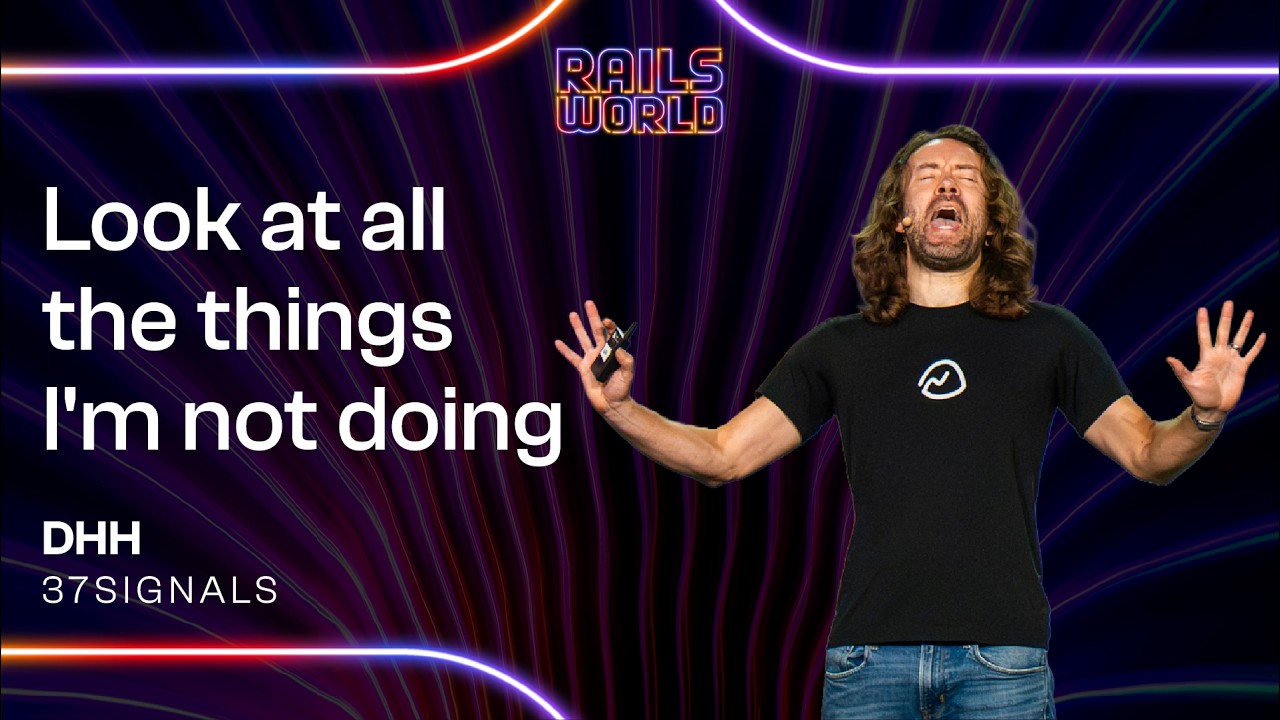
DHH is sold on AI coding and thinks most of coding will soon be done that way.
He says he found a programming language he likes even better than Ruby - English. This is a key insight: prompting is not programming; doc-driven development is a much better paradigm and still preserves some of the craft and dignity of programming.
DHH now likes programming in Rust (or at least the results Rust gives him - small, fast binaries), as long as he never has to look at the code.
He predicts some applications will transition from web to native, as it is now possible to create 5 different native apps in native languages without a lot of work.
Omarchy is his current passion.
Lastly, he encourages an optimistic view of the future.
There is not a lot in this video about Rails. YT summary of this question:
In this keynote, DHH presents Ruby on Rails as a framework uniquely positioned for the age of AI agents, arguing that its foundational principles are perfectly suited for this new era (33:04 - 34:00).
Key points DHH makes about Rails include:
- Convention Over Configuration: This long-standing Rails philosophy promotes token efficiency, which is highly beneficial when working with AI agents that may otherwise be overly verbose or prescriptive (33:34 - 34:00).
- One-Developer Framework: Rails has historically focused on enabling single developers to build and manage substantial applications. This goal aligns perfectly with the current environment, where agents empower individual programmers to achieve productivity levels far beyond what was previously possible (34:00 - 34:23).
- Continuous Evaluation: Rails is actively adapting to the agentic shift. The Rails Foundation, in collaboration with Evil Martians, has implemented agent evaluations (evals) to test how effectively agents can work with the framework. These evaluations are frequently updated as agents become more capable, demonstrating the framework’s commitment to staying at the forefront of this evolution (34:23 - 35:25).
- Role of the Web: While DHH discusses building native applications for specific high-fidelity needs, he emphasizes that the web remains a wonderful platform, especially for reaching ephemeral users who prefer not to install software. Rails is well-positioned to continue powering these types of applications effectively (33:04 - 33:34).