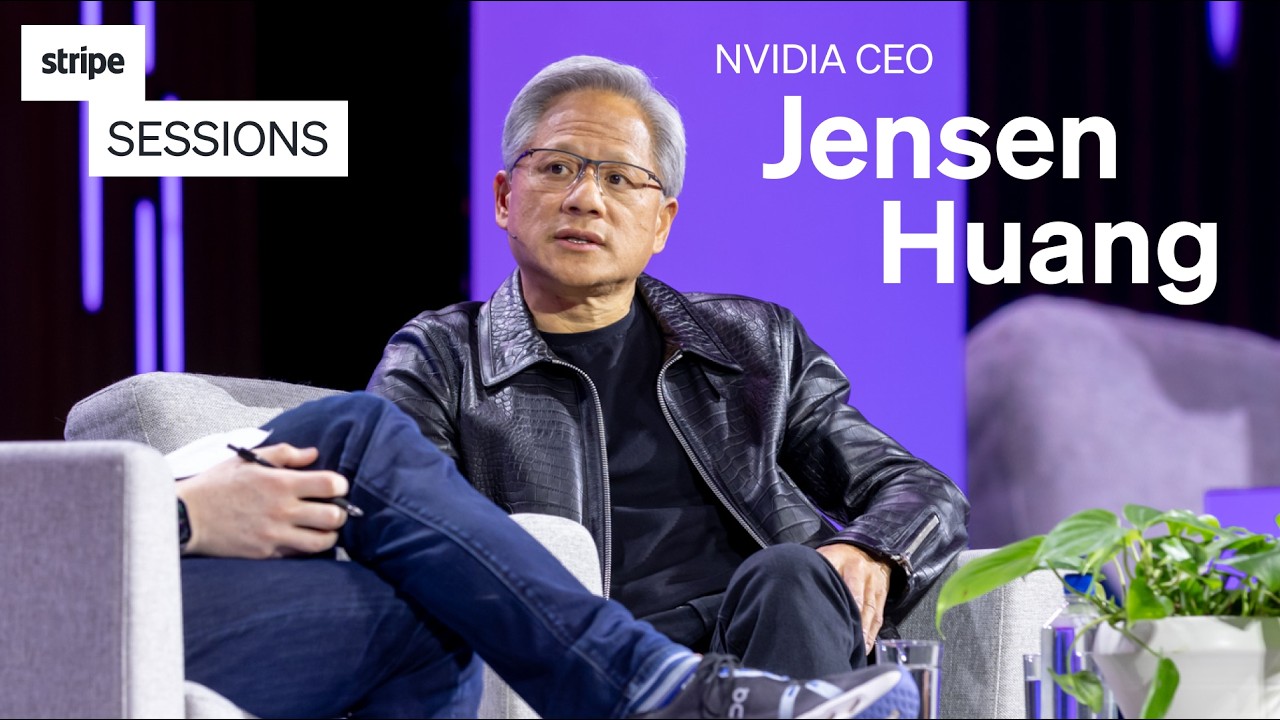
Jensen Huang and Patrick Collison Discussion
The previous post references this video:
Summary
The video is a conversation between NVIDIA CEO Jensen Huang and Stripe CEO Patrick Collison about leadership, long-term bets, CUDA, and the future of AI. Its central theme is conviction: pursue difficult ideas with clear reasoning, keep testing your assumptions, and build an organization that can persist long enough for those ideas to work.
Main takeaways
1. Meaningful work isn’t the same as constant happiness
Around 5:30–10:40, Huang explains his remark that he wishes people “pain and suffering.” His point is that doing something important inevitably involves struggle—not that suffering itself is the goal. He distinguishes loving your work or company from enjoying every day of it, and connects that attitude to his upbringing and early jobs cleaning bathrooms and working at Denny’s.
2. His management style prioritizes shared information over hierarchy
Around 10:50–18:00, Huang describes having more than 60 direct reports and avoiding one-on-one meetings. He wants leaders to hear the same problems, reasoning, and decisions directly, rather than gaining influence through privileged access to the CEO.
He also gives feedback in front of the group so everyone can learn from it, and says he prefers developing people rather than firing them. One important qualification: he explicitly says that having such a large number of direct reports does not necessarily work at lower organizational levels, where more supervision may be needed.
Information really matters. I believe that your contribution to… the work should not be based on the privileged access to information. I don’t do one-on-ones and I don’t… My staff is quite large, and almost everything that I say, I say to everybody all at the same time. And the reason for that is because I don’t really believe there’s any information that I operate on, that somehow only one or two people should hear about. And these are the challenges of the company or this is the problem I’m trying to solve, or this is the direction we’re trying to go into. These are the new endeavors. This isn’t working. That’s working well. And so all of this type of information everybody should be able to hear it. I love that everybody is working off of the same song sheet. I love that there is no privileged access to information. I love that we’re able to all contribute to solving a problem. And when you have 60 people in a room and oftentimes… Well my staff meetings are once every other week, and it’s all based on issues, whatever issues we have. Everybody’s there working on it at the same time, everybody heard the reasoning of the problem. Everybody heard the reasoning of the solution. Everybody heard everything. And so that empowers people. I believe that when you give everybody equal access to information, it empowers people. And so that’s number one, empowering. Number two, if the CEO’s direct staff is 60 people, the number of layers you’ve removed in a company is probably something like seven, depending on how it is.
[00:13:24] Patrick: 60 at every layer, or only 60? As in, if I’m one of the fortunate 60, do I also have 60 direct reports?
[00:13:33] Jensen: No. I also don’t think that that’s scalable downward. And the reason for that is because you need more and more supervision, depending on certain levels. And at the E-Staff level, if you’re so unfortunate to be serving on NVIDIA’s E-Staff, it’s very unlikely you need a lot of managerial.
Patrick: And so I rarely find myself having to stand up for conventional wisdom. But if I were to kind of steelman the other side, I’d say, well, one-on-ones are where you provide coaching, where you maybe talk through goals together, personal goals, career advancement, what have you. Where maybe you give feedback on something that you see somebody systematically not doing so well and so forth. So there’s all these things that kind of one is, again, conventionally supposed to do in the one-on-one. Do you not do those things or do you do them in a different way?
[00:14:26] Jensen: Really good question. I do it right there. I do it right there. I give you feedback right there in front of everybody. And in fact, this is really a big deal. First of all, feedback is learning. Feedback is learning. For what reason are you the only person who should learn this? Now you created the conditions because of some mistake that you made or silliness that you brought upon yourself. We should all learn from that opportunity. So you created the conditions, but we should all learn from it. Does that make sense? And so for me to explain to you why that doesn’t make sense or how I differ from it-- half the time I’m not right-- but for me to reason through it in front of everybody helps everybody learn how to reason through it. And so the issue-- the problem I have with one-on-ones and taking feedback aside is you deprive a whole bunch of people that same learning. Learning from mistakes, other people’s mistakes, is the best way to learn. Why learn from your own mistakes? Why learn from your own embarrassment? You got to learn from other people’s embarrassment. That’s why we have case studies. Isn’t that right? We’re trying to read from other people’s disasters, other people’s tragedies. Nothing makes us happier than that.
[00:15:56] Patrick: Have you succeeded in getting other leaders at NVIDIA to adopt this practice, or is that difficult?
[00:16:02] Jensen: I give people the opportunity to decide for themselves, but I really discourage one-on-ones. I really discourage one-on-ones. Nothing is worse than the idea that somebody says, “Oh, Jensen wants us to do this.” Why does that have to be said to anybody? Everybody should know. Or somebody said, “That E-Staff said that.” Nothing drives me nuttier than that.
[00:16:28] Patrick: You once told me that you really didn’t like firing people and very seldom did it. Can you elaborate on that?
[00:16:36] Jensen: Well, I’d rather improve you than give up on you. When you fire somebody, you’re kind of saying-- Well, a lot of people say, “It wasn’t your fault” or “I made the wrong choice” or-- There are very few jobs-- Look, I used to clean bathrooms, and now I’m a CEO of a company, I think you could learn it. I’m pretty certain you can learn this. And there are a lot of things in life that I believe you can learn. And you just have to be given the opportunity to learn it. I had the benefit of watching a lot of smart people do a lot of things. I’m surrounded by 60 people. They’re doing smart things all the time. And they probably don’t realize it, but I’m learning constantly from every single one of them. And so, I don’t like giving up on people because I think they could improve. And so there’s a-- it’s kind of tongue-in-cheek-- but people know that I’d rather torture them into greatness.
[00:17:29] Patrick: That was the phrase that I was hoping to uncover. Yeah, I remember you mentioned that.
[00:17:33] Jensen: Yeah. So I’d rather torture you into greatness because I believe in you. And I think coaches that really believe in their team torture them into greatness. And oftentimes they’re so close. Don’t give up, they’re so close. Greatness kind of comes all of a sudden, one day he’s like, “I got it”. Do you know what I’m saying? That feeling that you didn’t get it yesterday and all of a sudden one day something clicked. “Oh, I got it.” Could you imagine you gave up just that moment right before you got it? I don’t want you to give up on that, so I’ll just keep torturing you.
3. The CEO should solve problems, not sit through status reports
Around 20:00–22:10, he describes focusing on stalled projects, new ideas, and problems where his involvement can make a difference. He dislikes reporting meetings and leaves routine operations to other leaders. His view is that a CEO should work on things nobody else can—or nobody else is—doing.
4. His favorite opportunities are “$0 billion markets”
Around 22:10–26:20, Huang argues for creating markets rather than competing for a share of existing ones. A genuinely new capability may have no measurable market today because it doesn’t exist yet.
For those bets, he values an explicit explanation of why the technology should matter more than a spreadsheet forecasting demand. He also sees difficult, lengthy development as an advantage: less committed competitors may abandon the effort.
5. CUDA illustrates both the cost and payoff of that approach
Around 26:20–35:30, Huang describes CUDA as initially expensive and commercially disappointing. It added cost to NVIDIA’s chips before enough applications existed to make customers willing to pay for it, hurting margins. He says it took roughly ten years to really work.
NVIDIA kept finding smaller uses—CT reconstruction, seismic processing, and molecular dynamics—that helped sustain the effort. Huang’s explanation is that these applications bought time for the broader opportunity to emerge, and that NVIDIA’s AI success would not have been possible without CUDA.
6. Persistence needs a test that distinguishes it from stubbornness
Around 33:20–35:30, Collison asks how someone can tell whether to stick with an unpopular idea. Huang’s answer is to keep checking the underlying premises:
- Does the problem still matter?
- Have external conditions changed?
- Has someone else already solved it?
- Can you still explain why your approach should work?
Simply wanting an outcome is stubbornness; continuing because the reasoning still holds is a different matter. He pairs that persistence with finding practical ways to keep the project financially alive.
7. He sees AI as a new production industry, not just a software feature
Around 35:30–40:00, Huang presents two sources of computing demand: replacing conventional infrastructure with accelerated computing, and building “AI factories” that turn electricity and computation into valuable outputs such as text, images, and other generated content. This is his forward-looking business thesis, not a demonstrated inevitability.
8. Future AI will do more than generate a single answer
Around 41:20–45:25, Collison asks whether models eventually become good enough for specific tasks, limiting the value of further scaling. Huang responds that AI systems will increasingly plan, iterate, use tools, retrieve proprietary information, consult other models, and sometimes wait for human input. In that picture, capability comes from an entire problem-solving workflow—not just one larger model answering once.