Summary:
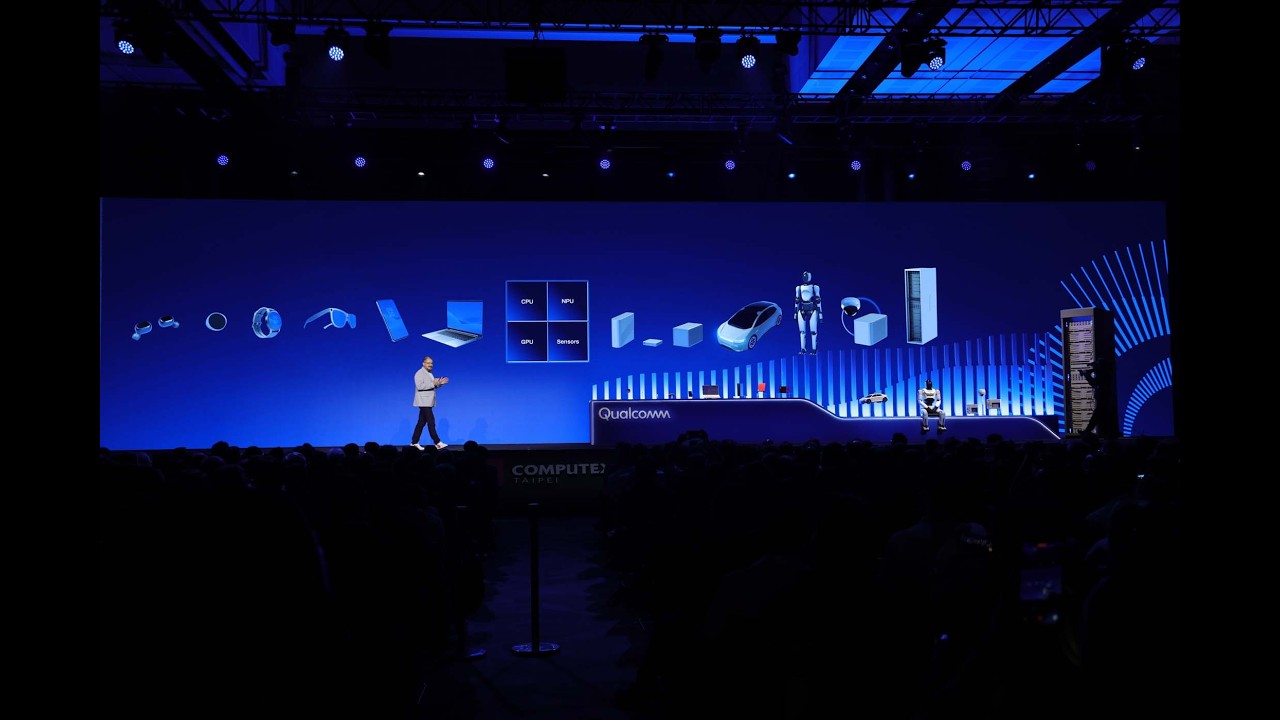
This keynote argues that 2026 is “the year of agents” and that AI agents, not smartphones, will become the center of people’s digital lives, following users across phones, PCs, cars, wearables, robots, and other devices.
Qualcomm’s core claim is that hardware and software must be redesigned for always-on, agentic workloads: strong but efficient CPUs to orchestrate tasks, dense low‑power NPUs/GPUs for on‑device models, and rich sensor integration for continuous context, all under tight power budgets. Personal devices effectively gain a second, machine-operated “persona,” with agents running in parallel to human interaction.
He extends this to cars and robotics as “physical AI,” combining cockpit/personal agents with perception and control stacks for driving and robots, and to industrial/vision AI where edge devices and cameras feed real-time context into agents. 6G is framed as AI‑native networking that adds distributed compute and RF sensing, turning the network into both an AI fabric and a massive environmental sensor for agents.
On the economics side, he describes tokens as the “currency of AI” and argues that agentic workflows will massively increase token demand, making a distributed cloud+edge model mandatory for cost and efficiency; Qualcomm claims distributed agents can cut tokens and cost by 30–60% in example workloads. Qualcomm positions itself as providing a full “compute continuum” from wearables to data centers and introduces the Dragonfly brand for its new data center products as the top end of this stack.