I wanted to understand how Nebula compares with WireGuard, Tailscale, OpenVPN, and the rest for connected products, so I wrote up this comparison.
OpenVPN, IPsec, WireGuard, Nebula, ZeroTier, Tailscale, and NetBird all build encrypted networks, but they solve different parts of the problem. Each has two parts:
- Data plane: how packets are encrypted and carried. WireGuard, OpenVPN, IPsec, Nebula, and ZeroTier each have their own.
- Control plane: how peers get keys, find each other, cross NAT, and learn who may talk to whom. WireGuard and IPsec leave this to you. Tailscale, NetBird, and Netmaker add it on top of WireGuard. Nebula and ZeroTier include their own.
How they relate
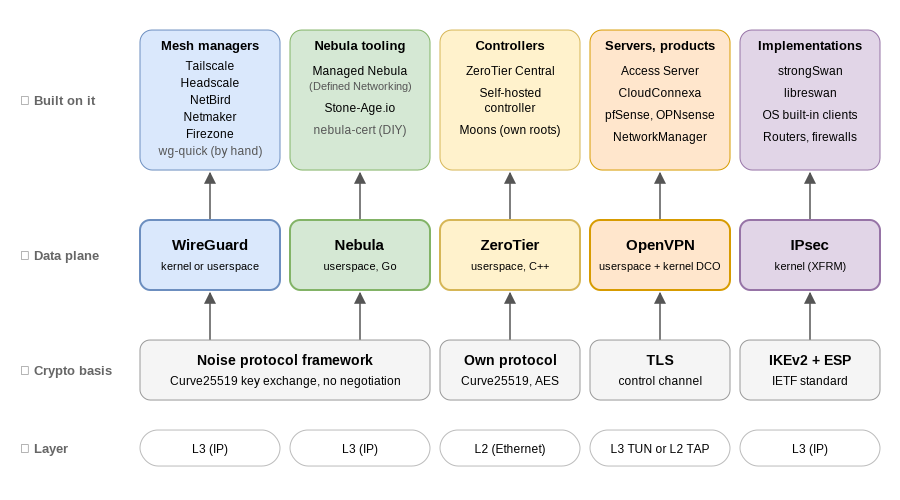
- Tailscale, Headscale, NetBird, Netmaker, and Firezone all carry traffic as WireGuard. They differ in the control plane: identity, key distribution, NAT traversal, and policy.
- Nebula and WireGuard both use the Noise protocol framework but are separate protocols that do not interoperate.
- ZeroTier is the only one here that emulates an Ethernet switch (L2), so broadcast and multicast work across it.
Topologies
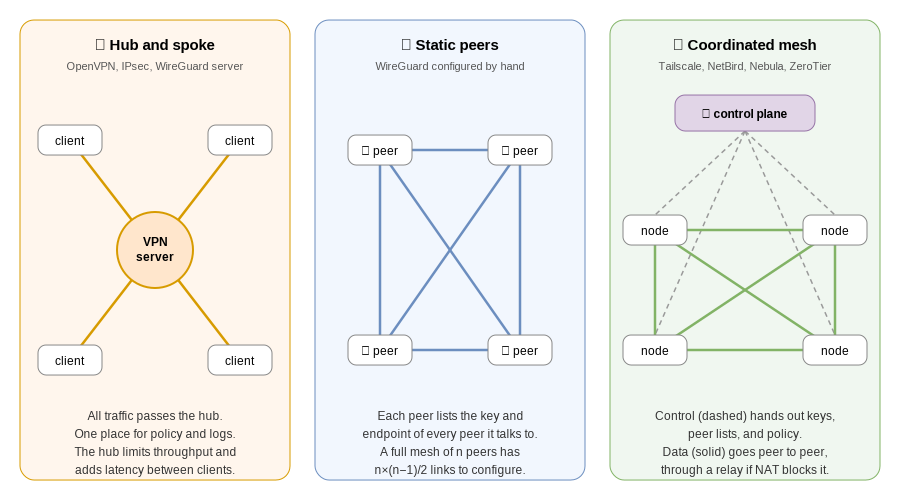
- Hub and spoke is the classic remote-access and site-to-site model.
- Static peers is plain WireGuard. It is simple for a few nodes and becomes hard to manage past a dozen.
- Coordinated mesh automates the static-peer model: a control plane hands out keys and peer lists, and traffic goes directly between nodes.
The technologies
OpenVPN
- Mature (2001), TLS-based, runs in user space over UDP or TCP. TCP on port 443 passes most restrictive firewalls.
- Supports L3 (TUN) and L2 (TAP) tunnels, certificates, username and password, and MFA through plugins.
- Data Channel Offload (
ovpn) moved encryption into the kernel in Linux 6.16. It requires OpenVPN 2.7 or later and falls back to user space when the module is missing. - Commercial offerings: Access Server (self-hosted) and CloudConnexa (SaaS).
OpenVPN fits today when the network or existing equipment sets the terms:
- Only TCP 443 gets out. Hotel, corporate, and some cellular networks block or throttle UDP. OpenVPN over TCP 443 looks like ordinary HTTPS traffic. WireGuard and Nebula are UDP only.
- You need L2. TAP mode bridges Ethernet, so broadcast, DHCP, and non-IP protocols cross the tunnel.
- It is already deployed and working. An existing PKI, client configs, and monitoring are worth keeping, and kernel DCO has mostly closed the throughput gap.
- The equipment only offers OpenVPN. pfSense, OPNsense, many consumer routers, and industrial cellular routers (Teltonika, Moxa) have mature OpenVPN support where WireGuard may be missing or newer.
- You need user login on the VPN itself. Username and password, RADIUS or LDAP, MFA plugins, and per-user routes and DNS are built in.
- Compliance requires it. TLS with a FIPS-validated OpenSSL can be easier to approve than WireGuard’s fixed algorithms, though IPsec is usually the stronger fit there.
For a new device fleet behind NAT, a mesh fits better: OpenVPN needs a reachable hub, routes all traffic through it, and has no peer-to-peer path.
IPsec (IKEv2)
- The IETF standard. Runs in the kernel, with IKEv2 negotiating keys and ESP carrying data. NAT traversal uses UDP 4500.
- Built into Windows, macOS, iOS, and Android, and into nearly every firewall and router, so it is the common choice for site-to-site links with enterprise or cloud gateways (AWS, Azure, GCP).
- Implementations on Linux: strongSwan and libreswan. Configuration has many options and interop requires matching proposals on both sides.
WireGuard
- A small protocol (about 4,000 lines in the kernel) in Linux since 5.6, with user-space ports (
wireguard-go,boringtun) for other platforms. - Fixed modern cryptography with no negotiation: Curve25519, ChaCha20-Poly1305, BLAKE2s.
- Cryptokey routing: each peer is a public key plus the IP ranges it may use. A peer’s address can change and the tunnel follows it.
- UDP only. No user identity, address assignment, peer discovery, or NAT hole punching.
PersistentKeepalivekeeps a NAT mapping open, but at least one side needs a reachable endpoint.
Nebula
- Open source (MIT) overlay network from Slack, written in Go, now developed by Defined Networking, which also sells Managed Nebula.
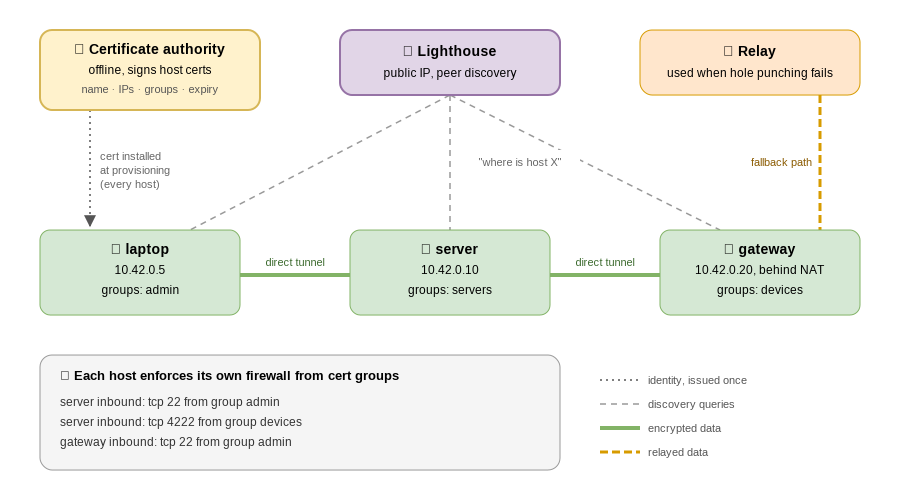
- Identity is a certificate. A CA signs each host’s certificate with its name, overlay IPs, groups, and expiry. The CA can stay offline, so no online auth server is needed for hosts to connect.
- Lighthouses answer “where is host X” and coordinate hole punching. Relays (since 1.6) carry traffic when hole punching fails.
- Every host runs a stateful firewall whose rules match certificate groups.
- Version 1.10 (December 2025) added IPv6 overlay addresses, several addresses per host, and a v2 certificate format.
- Revocation is a blocklist of certificate fingerprints that you distribute to hosts, so short certificate lifetimes are the practical control.
Tailscale and Headscale
- Mesh manager over WireGuard (
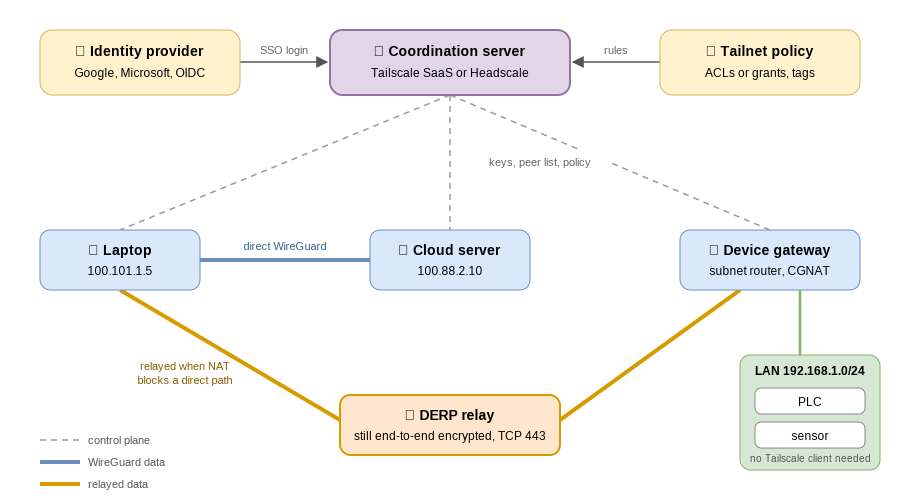
wireguard-goin user space). Clients are open source (BSD-3); the coordination server is a hosted service. - Login goes through an existing identity provider. Policy is a single tailnet file (ACLs or grants) using users, groups, and tags.
- NAT traversal is strong: direct connections in most cases, with DERP relays over TCP 443 as the fallback. Traffic stays end-to-end encrypted through DERP.
- Extras: MagicDNS, subnet routers (reach devices that run no client), exit nodes, Tailscale SSH, Serve and Funnel.
- Tailnet Lock lets nodes verify new keys themselves, so the coordination server cannot add a node on its own.
- Headscale is an open source (BSD-3) reimplementation of the coordination server for self-hosting. It covers the core features and lags the hosted service on newer ones.
NetBird
- Mesh manager over WireGuard, similar in scope to Tailscale, with a fully self-hostable control plane (management, signal, and relay services).
- Uses kernel WireGuard on Linux when available. SSO login, access policies, posture checks.
- Clients are BSD-3. Server components moved to AGPLv3 in v0.53 (August 2025), with a commercial license for those who cannot use AGPL.
ZeroTier
- Virtual Ethernet switch (L2) with its own protocol. Broadcast, multicast, and non-IP protocols work, which helps with device discovery and some industrial protocols.
- Network controllers manage membership; ZeroTier’s root servers help peers find each other. You can run your own controller and your own roots (“moons”).
- Licensing has changed several times. Since 1.16 (2025) the agent is MPL-2.0 and other components use ZeroTier’s source-available license, which requires a commercial agreement for commercial use. Check current terms before building a product on it.
Others worth knowing
- Netmaker: self-hosted WireGuard mesh manager using kernel WireGuard.
- Firezone: open source zero-trust access over WireGuard, aimed at giving users access to specific resources rather than whole networks.
- Defguard, innernet: smaller self-hosted WireGuard managers.
Comparison
| OpenVPN | IPsec (IKEv2) | WireGuard | Nebula | Tailscale | NetBird | ZeroTier | |
|---|---|---|---|---|---|---|---|
| Kind | Protocol and server | Protocol suite | Protocol | Overlay network | Mesh manager | Mesh manager | Overlay network |
| Layer | L3 or L2 | L3 | L3 | L3 | L3 | L3 | L2 |
| Data plane | TLS + own data channel | ESP | WireGuard | Nebula (Noise) | WireGuard | WireGuard | ZeroTier |
| Runs in | User space, kernel DCO | Kernel | Kernel or user space | User space | User space | Kernel or user space | User space |
| Transport | UDP or TCP | UDP 500/4500, ESP | UDP | UDP | UDP, TCP 443 relay | UDP, relay | UDP, TCP relay |
| Typical topology | Hub and spoke | Site to site, hub | Static peers or hub | Mesh | Mesh | Mesh | Mesh |
| NAT traversal | Needs reachable server | NAT-T, needs reachable gateway | Needs one reachable side | Hole punching, relays | Hole punching, DERP relays | Hole punching, relays | Hole punching, relays |
| Identity | Certificates, user login | Certificates, PSK, EAP | Public keys | CA-signed host certificates | SSO users, tagged devices | SSO users, setup keys | Node IDs authorized by controller |
| Access policy | Server config, firewall | Traffic selectors, firewall | AllowedIPs plus firewall | Per-host firewall on cert groups | Central ACLs or grants | Central policies | Flow rules on controller |
| Works offline | Yes, with local server | Yes | Yes | Yes, CA not needed at runtime | Existing peers keep working; changes need it | Same as Tailscale | Needs controller to join |
| Self-hosted | Yes | Yes | Yes | Yes | Via Headscale | Yes | Yes (controller, moons) |
| License | GPLv2 | GPL (strongSwan, libreswan) | GPLv2 kernel, MIT tools | MIT | Client BSD-3, server SaaS | Client BSD-3, server AGPLv3 | MPL-2.0 agent, source-available rest |
| Best fit | TCP 443 only networks, L2, existing deployments | Interop with firewalls and clouds | A few fixed links, building block | Fleets with their own PKI | Teams that want it working today | Tailscale model, self-hosted | L2 needs, broadcast discovery |
For connected products
Device fleets differ from office remote access. The points that matter most:
- Outbound only. Devices often sit behind cellular CGNAT or customer firewalls with no inbound ports. Mesh tools with hole punching and relays (Nebula, Tailscale, NetBird, ZeroTier) handle this. Plain WireGuard and OpenVPN need a reachable hub.
- Identity per device, issued at manufacture or enrollment. Nebula certificates fit a factory or provisioning flow well and need no online service at runtime. Tailscale and NetBird use pre-auth or setup keys with tags for unattended devices. See One Row Is the Device, Its Login, and Its Keys for a control plane that issues Nebula certificates and NATS credentials from one record.
- Least privilege. A support laptop should reach a device’s SSH port, and devices should not reach each other. Group- or tag-based policy (Nebula groups, Tailscale ACLs) expresses this directly.
- Dependence on a vendor. A hosted control plane is convenient but is a dependency for every device you ship. Prefer something you can self-host or move away from: Headscale, NetBird, or Nebula with your own CA.
- Licensing for a shipped product. MIT (Nebula) and BSD (Tailscale and NetBird clients) are simple to ship. Review AGPL server components and source-available terms (ZeroTier) before you depend on them.
- Embedded footprint. Kernel WireGuard is the smallest option (
CONFIG_WIREGUARD,wireguard-toolsin Yoctometa-networking). Nebula, Tailscale, and NetBird are single Go binaries of several megabytes each.
A reasonable default:
- Nebula for a device fleet you own end to end, especially when devices must keep working without an internet-hosted control service.
- Tailscale (or Headscale) for engineering access to servers, gateways, and lab devices, where SSO and fast setup matter most.
- IPsec when the other end is a customer’s firewall or a cloud VPN gateway.
- WireGuard by hand for a few fixed links between machines you control.
- OpenVPN when devices sit on networks that pass only TCP 443, when a router offers nothing else, or when an existing deployment is working well.
Local network management
NetworkManager and systemd-networkd both configure interfaces, addresses, routes, and (through systemd-resolved) DNS. None of the VPN tools require either.
| Tool | NetworkManager | systemd-networkd |
|---|---|---|
| WireGuard | Native since 1.16 (nmcli connection import type wireguard file wg0.conf) |
Native: a .netdev with Kind=wireguard plus a .network |
| OpenVPN | Plugin (NetworkManager-openvpn): GUI, .ovpn import, keyring secrets |
None. Run openvpn as its own service |
| IPsec | Plugins (NetworkManager-strongswan, NetworkManager-libreswan) |
None. Run strongSwan or libreswan as its own service |
| Tailscale, NetBird, Nebula, ZeroTier | None. Mark the interface unmanaged | None. Interfaces without a matching .network are left alone |
How the two compare:
| NetworkManager | systemd-networkd | |
|---|---|---|
| Configuration | Connection profiles through nmcli, a GUI, or D-Bus |
Static .network and .netdev files |
| Wi-Fi | Built in (wpa_supplicant or iwd backend) | Run wpa_supplicant or iwd alongside it |
| Cellular | Integrates with ModemManager | Limited; usually needs ModemManager or vendor tools plus glue |
| Runtime API | Full D-Bus API to create and toggle connections | Status, reload, and per-link settings; configuration lives in files |
| Footprint | Separate daemon with GLib and D-Bus | Part of systemd, usually already in the image |
| Secrets | Keyring or secret agent | Key files readable by the systemd-network group |
| Best fit | Desktops, gateways with Wi-Fi, cellular, or changing uplinks | Servers and devices with fixed networks |
- Keep managers off mesh interfaces. For NetworkManager, list them as unmanaged in
NetworkManager.conf:unmanaged-devices=interface-name:tailscale0;interface-name:wt0;interface-name:nebula*;interface-name:zt*. systemd-networkd ignores interfaces with no matching.network, so keep[Match]sections specific and avoidName=*. - Split DNS. A VPN should send only its own domains to its DNS servers. Both managers and the mesh daemons do this through systemd-resolved; in systemd-networkd, pair
DNS=withDomains=~corp.example. Without resolved, tools overwrite/etc/resolv.confand conflict. Under systemd-resolved, aDNS =line in awg-quickconfig registers a catch-all domain, so every lookup fails when the VPN’s DNS servers are unreachable.
A WireGuard client in systemd-networkd, with no wg-quick:
# /etc/systemd/network/50-wg0.netdev
[NetDev]
Name=wg0
Kind=wireguard

[WireGuard]
# owned root:systemd-network, mode 0640
PrivateKeyFile=/etc/systemd/network/wg0.key

[WireGuardPeer]
PublicKey=<server public key>
Endpoint=vpn.example.com:51820
AllowedIPs=10.8.0.0/24
PersistentKeepalive=25
# /etc/systemd/network/50-wg0.network
[Match]
Name=wg0

[Network]
Address=10.8.0.2/24
DNS=10.8.0.1
Domains=~corp.example
On a Yocto device, NetworkManager fits when it already manages Wi-Fi and cellular: use its native WireGuard or the OpenVPN plugin, and mark the mesh tool’s interface unmanaged. On a device with a fixed network, systemd-networkd is smaller, keeps the whole configuration in files that can ship in the image, and has fewer moving parts.
Related approaches
These are not VPNs, but often solve the same need of reaching a device:
- Reverse tunnels (Cloudflare Tunnel,
ssh -R, frp) expose one service through an outbound connection. See Pieter Levels’ I recommend taking your VPS off the public internet with Tailscale and Cloudflare Tunnel. - Messaging with outbound connections (NATS leaf nodes, MQTT) carries application data and commands without giving network access to the device.
References
- WireGuard whitepaper
- OpenVPN Data Channel Offload
- strongSwan documentation
- Nebula documentation
- Nebula IPv6 and v2 certificates
- How Tailscale works
- How NAT traversal works
- Headscale
- NetBird AGPL announcement
- ZeroTier documentation
What are you using to reach devices in the field, and what has worked well? Corrections are welcome.