To expand on the JetStream store note above: v0.19.0 through v0.27.0 went out between July 31 and September 2. Here is a short summary of each release; the linked GitHub release has the full notes.
Every release since v0.19.0 can be installed with siot update.
GPS client reads position from a serial NMEA receiver, gpsd, or a built-in simulator, and publishes lat/lon, altitude, speed, heading, fix status, and satellite info. The docs include plotting a track on a Grafana geomap.
siot update downloads the latest release for your platform, verifies checksums, and replaces the binary in place. siot update -check reports what is available.
Releases publish the siot executable directly instead of an archive, built by GitHub Actions from a version tag.
(Breaking) the legacy gps package is removed in favor of the GPS client.
Zephyr shell protocol mode for the MCU serial client. Points are exchanged as ASCII lines with the MCU console shell rather than COBS-framed binary, so the link a developer reads is the link Simple IoT uses. A “Log console output” option mirrors the MCU console into the server log.
Serial client fixes. A closed port no longer leaves a goroutine spinning, the connected state is self-correcting, and the serial node UI shows MCU data rather than the node’s own settings.
Thermal, power, and clock metrics. The metrics client now collects fan speed and PWM, thermal cooling device states, rail voltage/current/power from hwmon power monitors, per-CPU clock frequency, and SoC temperatures from Linux thermal zones. Boards like the Jetson AGX Orin now report CPU, SoC, and junction temperatures alongside board sensors.
Modbus and 1-Wire move to the client architecture. A new bus or IO starts right away instead of waiting on a 20-second store scan, and buses inside groups now run. The old node package and its scan are gone.
Modbus fixes:int16 values decode as signed, valueSet writes go out immediately, a zero scale is treated as one, and the subsystem has its first end-to-end tests.
1-Wire bus nodes are no longer created automatically. Add a 1-Wire node and set its Index to the bus controller number. Sensors on that bus are still detected for you.
One YAML format for export, import, and provisioning. Node types are keys, point types are keys, and files carry configuration only: no IDs, no origins, no empty points. Files in the previous format are not read; re-export to convert.
Import is idempotent. Nodes are matched by description, so applying a file twice does what applying it once did. -dryRun shows what a file would do.
Provisioning from files. A directory of files is applied at start-up and whenever a file changes, so a unit built from an image comes up configured. Files can also be uploaded through the UI.
New store. The SQLite store and hash tree are replaced by JetStream boundary-origin streams (ADR-7), with in-memory point and edge caches. Existing databases must be migrated:siot export with v0.22.0, then siot import with v0.23.0.
Sync rewritten on stream replication: continuous, durable, resumable in both directions. The Sync Period setting is gone.
Unified point encoding replaces Value/Text with DataType/Data and drops protobuf for a compact binary format.
Database client gains a type selector for InfluxDB 2.x or Victoria Metrics and reads from store streams, so external history is gap-free across outages and restarts.
The history.<nodeId> NATS API is removed; graph time series with Grafana instead.
Point types and keys may not contain a period, whitespace, or a NATS wildcard. Such points were delivered to the wrong handler. Rejected points are logged and flagged with an error point on the node. This affects existing devices that send keys like PCIe_bridge_0.95V. The metrics client now sanitizes kernel-generated names.
The documentation site now uses the simpleiot.org palette and typography.
Prometheus scrape in the metrics client. An application’s /metrics endpoint on loopback can report upstream with no open port or second agent. Labels expand into database labels so scraped series query the way they did in Prometheus.
JetStream streams are S2-compressed by default. A store of 100,000 points went from 33.4 MB to 11.7 MB.
Default retention raised from 5,000 to 20,000 points per subject, about four months of 10-minute data.
siot dump describes a running instance for troubleshooting: root ID, tree with node IDs, deleted nodes, and optionally points and stream inventory.
Sync replicates in windows of up to 256 messages, so a first sync of a large stream finishes in a fraction of the time. A failed window is resent as a unit so subjects arrive in order.
An upstream no longer adopts a downstream instance’s root as its own.
Notifications work again, with Twilio SMS, SMTP email, and ntfy push delivery configured on a Messaging Service node. Notifications now travel as ordinary points, so they are stored, synced, and visible in history. Testing feedback welcome.
New documentation pages on PLC options, high availability, and planned TimescaleDB support.
Rule improvements. Notify actions take a repeat interval, conditions can hold themselves active with minInactive, and minActive is now enforced (a rule already carrying a non-zero value changes behavior on upgrade). Actions run only when the rule changes state, so editing an active rule no longer re-sends its notification.
GPIO client. A gpio node reads or drives one line on a Linux GPIO character device, so a rule can watch a float switch and run a pump. Set the chip to sim to develop rules before the hardware exists.
Mirrored hardware nodes no longer run a second client, and a valueSet on a mirror reaches the device that owns the hardware. Mirrors made before this release keep the old behavior until removed and recreated.
Deleting a node removes its mirrors, nodes that belong to a parent can only be mirrored rather than moved, and mirrors are labeled in the tree.
Shelly Gen2+ devices are read from what they report rather than a model list, so new devices and add-on modules work. Cover, energy meter, temperature, humidity, and battery components are supported.
Shelly status arrives by push over a WebSocket instead of two-second polling. Discovery no longer misses devices on a busy network, and the Plus 1PM, Plus i4, and RGBW2 report correctly.
Analog IO through Linux IIO. An iio node reads ADCs, DACs, and sensors the kernel presents the same way, with channels detected automatically and minChange to keep ADC noise out of the store. Not yet tested on real hardware.
Per-device credentials for sync. Each instance generates a device key on first start, and an upstream accepts it through a deviceCred node that limits the connection to that device’s own data. SIOT_DEVICE_AUTH=required makes every remote connection use one.
Devices can enroll themselves with a fleet-wide enrollment token, then be approved from the UI or with siot cred approve. Credentials can also be managed with siot cred list|approve|enable|disable|rm.
siot export leaves secrets out unless -secrets is passed.
The web UI carries the [siot] logo and favicon from simpleiot.org.
Simple IoT v0.28.0 follows a security audit and tightens access control throughout, and it also brings live web UI updates, TLS for the NATS WebSocket, and mirrors that reach every device. Before upgrading, note that the web UI moves to port 4223 and that devices and upstreams need to be upgraded together.
A signed-in user cannot reach nodes outside their groups through any door.
The HTTP node routes now resolve every request to a principal and refuse a
node, or a parent named in the body, outside what it may reach; a browser’s
edge write checks the child as well as the parent, so a node cannot be
attached into a group from elsewhere; and a rule action, signal generator
destination, or serial high-rate destination that names a node above the
client’s parent is refused with the error recorded on the node. A rule that
reaches across groups has to move to a level that contains both. See the security reference.
A request with no credentials is refused on the HTTP node routes, whether
or not SIOT_AUTH_TOKEN is set. A script that relied on an empty header
against an instance with no token has to sign in or present the token.
A user under a device signs in on that device only. A device’s users are
replicated to the upstream with the rest of its tree, but are not accepted at
the upstream’s sign-in, even after their password is set from the upstream’s
UI, so a device left with its default admin account is not an account on the
upstream. See users and groups.
Node replies to a browser or API user leave secret values out.pass, authToken, enrollToken, sid, and psk points arrive with an empty
value, replies list only the parents inside the user’s groups, and siot export leaves every one of these types out unless -secrets is given.
Sign-in attempts are limited per account and logged, over HTTP, NATS, and
the browser’s WebSocket: five failures in a row refuse the account for a
second, doubling up to five minutes. A user’s token is refused as soon as the
user is gone from the tree.
The device key seed never leaves the server.auth.deviceKey answers with
the public key only; the sync client has the server sign for it on auth.deviceSign. client.GetDeviceKey and client.Enroll changed
accordingly.
Enrollment is bound to the connection and the device. A request has to
name the key on its own connection, the device ID has to be usable in a
subject, a device that already has a live credential gets any further key as
pending whatever the token says, and at most 100 devices may wait for
approval.
Under SIOT_DEVICE_AUTH=required, the shared token is refused from a remote
address through the HTTP port’s WebSocket proxy as well as on the NATS port.
A reverse proxy in front of the HTTP port still makes connections look local;
see the security reference.
A bad point no longer stops the instance. A node whose points do not
decode, or a client that panics, records the problem on the node’s error
point and is restarted with backoff while everything else keeps running.
Periods read from points are bounded before they reach a timer, a signal
generator refuses a sampleRate above 1 MHz, and a serial node’s maxMessageLength is capped at 64 KiB.
Modbus requests and responses are bounded. A request for more than 125
registers or 2000 coils, or for zero, gets an illegal-data-value exception; a
response whose length disagrees with the request is an error; and a connection
over a Modbus TCP server’s client limit is closed.
Messages go to the address on the user node, at a bounded rate. A message point raised on any node other than a user node is ignored, the
phone and email in the point are never used, and each messaging service sends
at most 30 messages at once and then one every 30 seconds. CR and LF are
stripped from SMTP headers.
Inputs taken from points and peers are validated. The update client
requires https and caps its downloads; kiosk browser and NTP settings refuse
control characters; IIO, OneWire, audio, and transferred file names cannot
leave their directory; a Shelly ip has to be an address, and a known device
is only moved when the device at the new address reports its MAC; a serial MCU
or Particle device can no longer rewrite its node’s configuration; the
Particle token travels in a header. An update node with an http URI stops
fetching until the URI is changed.
MQTT filters on a node inside a group must start with a literal topic
level.# and +/... are refused with an error on the node; an mqtt node
directly under the root may use any filter, and maxNodes also caps the nodes
Sparkplug creates. An existing subscription to # under a group stops
working. See MQTT.
The HTTP server has timeouts, a 4 MB body limit, and security headers, the
debug logger no longer logs sign-in bodies, the UI fonts are served from the
binary so the page loads no third-party origin, and the JWT signing key on a
new store is 32 bytes.
Added
A node mirrored into several devices now reaches all of them. A setpoint
kept on the upstream and mirrored into each device at a site arrives on every
one, with its current values as soon as the mirror is made, and removing a
mirror removes it from that device only. A change made on a device still
reaches the upstream and not the other devices. A mirror made before the
upgrade gets new writes right away and current values on its next edge change,
or at once if it is removed and made again. See a node reaches every device it is mirrored into.
The NATS WebSocket listener serves TLS when SIOT_NATS_TLS_CERT is set,
the server’s own loopback connection and the HTTP port’s proxy accept exactly
that certificate, and a sync node can pin its upstream with a caCert point.
See configuration and synchronization.
SIOT_OUTBOUND_DENY_PRIVATE refuses connections to loopback, link-local,
and private addresses from the metrics scraper, Shelly, ntfy, Modbus TCP, and
gpsd clients, for an instance on a network it should not probe. Everything is
allowed by default.
siot install produces a service that is not open to the network. It
generates an auth token into a 0600 environment file, creates the data
directory 0700, and, as a system service, adds systemd sandboxing. A client
that needs hardware access is allowed it in a drop-in; see installation.
Browsers connect to NATS as the signed-in user. The embedded NATS server
accepts a user’s node ID and sign-in JWT as user and password, over the
WebSocket the HTTP port already proxies, and limits the connection to the
groups that user belongs to. Removing a user from a group, deleting the user,
or changing the password closes the connection within seconds, and a
connection is closed when its JWT expires. New subjects u.<anchor>.<user>.>
and auth.me, and a depth parameter on nodes requests, serve it. SIOT_NATS_WS_ORIGINS limits which page origins may open the WebSocket;
empty, the default, allows any. See the API reference
and security reference.
Changed
An OS update download stops before it fills the disk. The size limit is 1
GiB, larger than any update image and smaller than the storage on a typical
device. A server that declares an oversized image is refused before anything
is written, and a download that would not leave 64 MiB free in the destination
directory does not start. See update.
A copied node stays on the clipboard after a mirror or a duplicate, so it
can be pasted into several destinations in a row. A move still clears it, and
the x next to the clipboard entry clears it at any time.
The web UI moves to port 4223, and one setting now moves every port. The
HTTP port defaults to one above the NATS port (4222) and NATS monitoring to
two above it, so SIOT_NATS_PORT alone moves a second instance off the
defaults; SIOT_HTTP_PORT and the new SIOT_NATS_MONITOR_PORT still override
them. Monitoring and the NATS WebSocket now listen on loopback only, and the
WebSocket takes a free port the HTTP port finds on its own. SIOT_NATS_HTTP_PORT, SIOT_NATS_HTTP_HOST, SIOT_NATS_WS_PORT, and SIOT_NATS_WS_HOST are gone. Update bookmarks, firewall rules, and reverse
proxies that name 8118, and an installed service’s siot.service, which sets
the old ports until it is regenerated. See configuration.
The web UI updates live instead of polling. The page keeps one NATS
connection over the WebSocket the HTTP port proxies, fetches nodes as you
expand the tree, and shows point changes for the nodes on screen as they
happen. A connecting... badge appears while the connection is down. See live updates.
simpleiot-js 2.0 connects as a user and speaks the binary encoding. The
JavaScript client in frontend/lib is rewritten on the point and node
encoding the server has used since protocol buffers were dropped, connects
with a sign-in JWT, and names the group every read and write is made under.
The protobuf-based API of 1.x is gone. See the frontend reference.
Devices get a reply inbox of their own. A device credential used to be
granted the _INBOX.> space every client on a server shares, so one device
could read every other client’s request replies. Each connection now gets an
inbox named for its key. A device enrolling itself presents the key it is
enrolling alongside the enrollment token, so it gets an inbox too; an
enrollment token on its own is no longer accepted. Devices and upstreams have
to be upgraded together, since neither inbox grant covers the other. See the security reference.
The security reference has a deployment checklist and a list of known
limitations. A security audit found that an instance with no auth token or
with the default admin password, including on an edge device that syncs
upstream, is open to anyone who can reach it. See the security reference before
exposing an instance to a network.
Builds require Go 1.27.1, and releases are built with the version go.mod
names. Release binaries were built with Go 1.25.0, the minimum the module
declared, rather than the version CI tested with. CI now checks dependencies
with govulncheck as well.
Fixed
A node deleted on a device disappears from the upstream’s UI right away.
Before, it stayed on screen until the page was reloaded.
Sync to an upstream with no token stays connected. The upstream no longer
drops a device each time its tree changes; before, the device reconnected a
few seconds later.
A node mirrored onto an upstream keeps syncing to its device. Mirroring a
node with no primary location – a variable, a user – from a device subtree
into the upstream tree moved the node’s ownership to the upstream root, so
values written on the upstream were stored where the device never reads them
and never arrived. Ownership now stays with the device. See primary and mirror edges.
An instance with a large store starts reliably. Loading the store at
start-up could outlast the server’s wait for its own NATS connection, so the
process exited and restarted in a loop without ever serving. The server now
connects once the store has loaded.
A tree with many nested groups no longer exhausts memory. Looking for
nodes to run clients on counted nodes again for every group it passed through,
so a large tree of groups could use all of the system’s memory. Each node is
now found once.
Device credentials on the upstream stay marked connected while the device is
connected. A device could clear this status on its own copy of the
credential a few seconds after connecting, and the change synced back
upstream.
Removed
GET /v1/nodes is gone. It returned every node a user could see in one
reply, and the web UI was its only caller. The other node routes stay.
auth.getNatsURI is gone. It handed the shared token to any connected
client. Nothing in the repository used it; a client that did should hold its
own credential.
To update, run siot update, or download the binary for your platform from the releases page.
Simple IoT v0.28.1 through v0.28.3 are follow-up fixes to v0.28.0, focused on faster, steadier starts and memory use on large stores. The linked GitHub release has the full notes.
SIOT stays within a memory limit set for its service. When systemd’s MemoryMax or a container limit applies, SIOT frees memory more eagerly as it approaches the limit, rather than being stopped on reaching it. GOMEMLIMIT overrides this.
An instance that stores data synced from devices no longer spends minutes at full CPU after it starts. It now reads only the latest value of each point.
Point types and keys may not contain a NUL byte or invalid UTF-8. One such point could make every restart rebuild a stream, which is slow and uses a lot of memory on a large store.
A device enrolling or connecting is no longer disconnected by a tree change at the same moment, and a setting changed right after adding a node is no longer lost.
To update, run siot update, or download the binary for your platform from the releases page.
Simple IoT v0.28.4 through v0.31.0 went out between October 12 and October 29. The headline is a new web UI in v0.30.0. Here is a short summary of each release; the linked GitHub release has the full notes.
Devices are confined to their own data on the upstream. The upstream creates each device’s replica stream, ignores writes outside the device’s subtree, and no longer lets a device list other instances. A second audit found that any account can still create a device credential, enrollment token, or sync node, so give accounts only to people you trust with the whole instance. See known limitations.
Much less cellular data. An idle device went from about 25 MB a day to about 2 MB. Sync no longer polls for new streams, and store metrics are off by default. Sync nodes now show bytes sent and received. Upgrade devices and their upstream together. See the bandwidth reference.
MCU firmware updates over the shell-mode serial link. Point a serial node at a signed MCUboot image and Simple IoT installs it when it is newer, so MCU firmware ships inside the OS update. Auto apply firmware finishes the update in one restart, and an image the MCU rejects is not retried. See firmware update.
Faster, cleaner restarts. Shutdown no longer waits on the metrics client, the database client, or the store’s stream scan, and the running version is recorded even when the store starts up busy.
(Breaking) COBS encoding follows the specification for packets with a run of 254 or more non-zero bytes. MCU firmware with a standard COBS decoder needs no change.
Enrollment tokens place new devices in their own group. Put a token in a group, and each device that enrolls with it appears there on first connect. Auto approve now covers only devices the enrollment creates.
A new web UI, built with Svelte, replaces the old one at /. It adds a link to each node, remembered expansion, search, keyboard navigation, a dark theme, and each node’s type and status in the tree. The old Elm UI stays at /old until a later release removes it. See the UI guide.
Import and provisioning files can set the instance’s own description and tags with a root: section, and sync recovers more reliably from dropped connections.
Online status for devices and sync connections. The upstream marks each device online or offline, and sync nodes show whether the upstream is connected, both with the time since. Online state is now a 1/0 online point you can graph; rules that matched sysState text need updating.
Shorter IDs. New nodes get 26-character IDs instead of 36-character UUIDs, which saves about 50 bytes per point on the sync link. Existing IDs are unchanged.
A clone builds with Go alone, since the web UI build is committed with the source.
To update, run siot update, or download the binary for your platform from the releases page.
Simple IoT v0.31.1 and v0.32.0 went out today. The headline is faster catch-up after a device reconnects, and the documentation now has diagrams throughout. The linked GitHub release has the full notes.
Expanding a tree shows changes made while it was collapsed. Nodes that come back into view now show their current values, including changes made from another browser.
Documentation diagrams are redrawn as SVG in one consistent style. They stay sharp at any size and follow the light or dark theme. The new Diagrams page holds the style guide and a gallery.
Current values arrive first after a reconnect. While sync catches up a backlog, it sends the current value of each changed subject ahead of the history, so the other side is current within seconds instead of when the backlog finishes. Rules on the receiving side see current values rather than a replay. Upgrade the upstream first; older and newer instances still work together. See Offline catch-up.
New diagrams across the documentation. Data, storage, sync, enrollment, authorization, the browser, high availability, notifications, bandwidth, PLCs, MQTT, IIO scaling, provisioning, and file transfer each have one. See the Diagrams gallery.
To update, run siot update, or download the binary for your platform from the releases page.
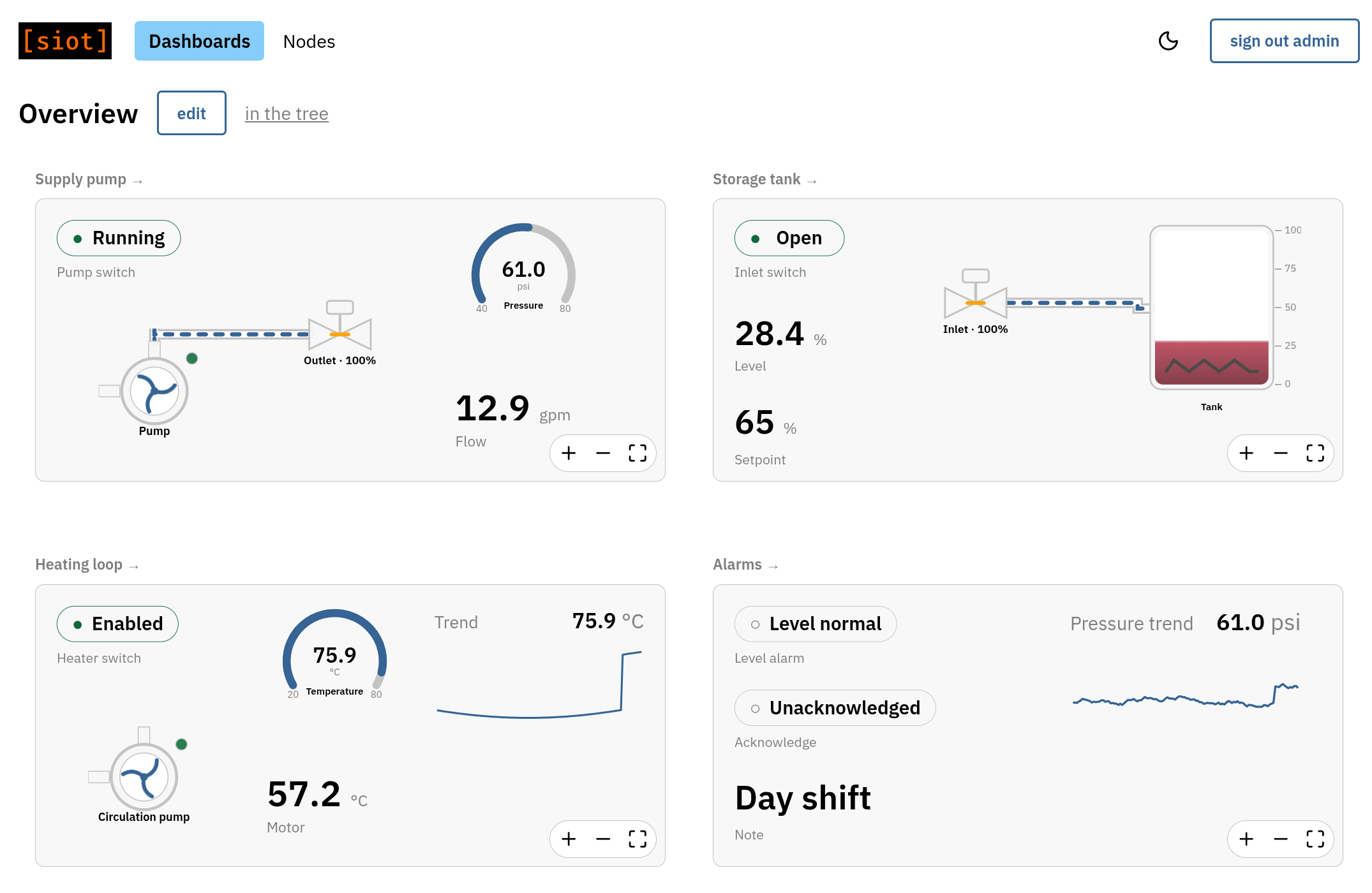
Simple IoT v0.33.0 is out. The headline is dashboards: live pages of gauges, values, status pills, and trends, and canvas mimics of tanks, pumps, and valves, all built from nodes so they sync like everything else. The linked GitHub release has the full notes.
Dashboards. A dashboard is a node holding widget nodes, each bound to points on other nodes, and it syncs like any other node. The web UI lists dashboards under Dashboards and shows each as a grid of value, gauge, status, and trend widgets that reflows to one column on a phone. Edit mode adds, drags, resizes, and configures widgets in place. A user’s home dashboard, set on the user node, is where signing in lands. A canvas layout draws process mimics with tank, pump, and valve components and links drawn from port to port, which follow the equipment when it moves. A binding can be a path relative to the dashboard’s parent, so one dashboard mirrored under several devices shows each device’s nodes, and a nested dashboard component shows one dashboard inside another. A status widget on an on/off variable is a switch, and a value widget on a variable or an output is a setting with an edit box; a confirm option asks before a change is sent. A scale option sizes any widget, a canvas widget is resized by its corner, and a widget can be duplicated, or copied and pasted into another dashboard. testdata/dashboard-demo.yaml is a demo to import. See dashboards.
Conditions and actions pick their node by description. Typing in the Node field searches the server and lists matches with where they sit; the chosen node shows as a link, and the point type and key fields offer what that node carries. The node ID text field and paste button are gone. See rules.
Node requests can search by description and type. A search point on a nodes.<id>.all request returns the nodes below id whose description, ID, or type matches, with their ancestors, so a client can find a node it has not loaded. A nodeType point limits matches to that type, and an empty search then lists every node of the type. See the API reference.
Configuration files resolve dashboard references by description. A widget’s bindNode points and a user’s homeDashboard name their node by description, as nodeID does, and export the same way.
A rule starts from the current value of the nodes its conditions watch. A rule that watches a switch which is already on is active as soon as it starts, rather than waiting for the switch to change. Before, the switch had to be turned off and on again before the rule followed it. See rules.
A signal generator continues where it stopped. Disabling a generator and enabling it again, or changing its range, rate, or frequency, continues the signal rather than starting it over from the initial value. See the signal generator.
Signing in returns to the page that asked for it. A link to a dashboard or a widget’s settings opened while signed out lands there after sign-in, rather than on the home page.
The node tree moved to /nodes. The address / now lands on the user’s home dashboard, the dashboard list, or the tree, in that order of what exists. Bookmarks to /nodes/<id> are unchanged.
To update, run siot update, or download the binary for your platform from the releases page.