NemoClaw
Summary:
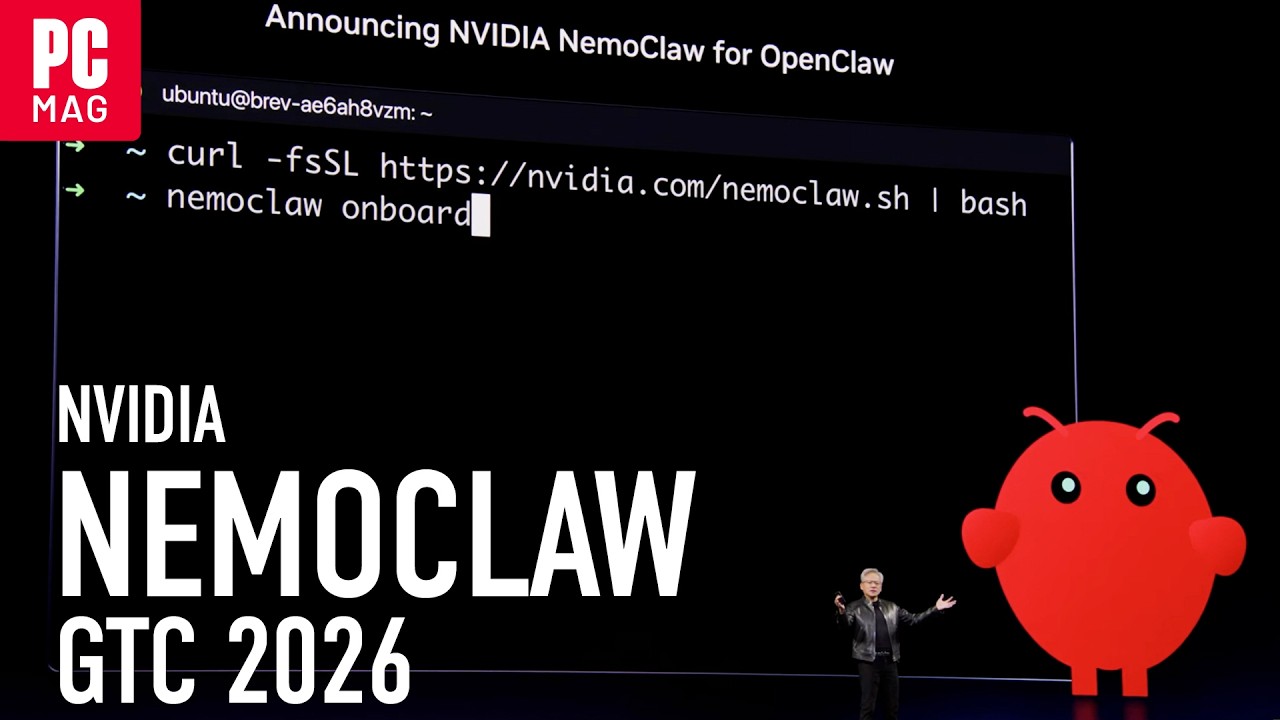
Nvidia’s GTC 2026 segment announces “NemoClaw,” an enterprise‑grade, secure stack built around the wildly popular open‑source agent framework OpenClaw, positioning it as the “operating system” for AI agents in companies.
What OpenClaw Is
- OpenClaw is described as the most popular open‑source project ever, surpassing Linux adoption speed and becoming the de facto standard for agentic AI systems.
- It orchestrates resources (tools, file systems, LLMs), scheduling (cron‑like jobs, task decomposition), and sub‑agents, with multimodal I/O (text, voice, gestures, messages, email).
- Jensen Huang explicitly likens it to an operating system for “agentic computers,” analogous to how Windows enabled personal computers and Kubernetes enabled cloud.
Why It Matters for Enterprises
- Huang argues every software and tech company now needs an “OpenClaw strategy,” similar to having strategies for Linux, HTTP/HTML, and Kubernetes in earlier eras.
- He contrasts “before OpenClaw” IT (data centers as file holders plus classic software tools and workflows) with a “post‑agentic” world where SaaS vendors effectively become “agent‑as‑a‑service” providers (SaaS → “GaaS”).
The Security and Governance Problem
- Agentic systems inside corporate networks can access sensitive internal data, execute arbitrary code, and communicate externally, which Huang emphasizes is unacceptable without strong controls.
- Risks include exfiltrating employee, supply chain, and financial information, or performing ungoverned actions across internal systems and external channels.
Nvidia’s NemoClaw and OpenShell
- Nvidia worked with OpenClaw’s creator Peter Steinberger and security experts to harden OpenClaw for enterprise use, producing a reference stack called NemoClaw.
- A core component, OpenShell, is integrated into OpenClaw to make it “enterprise ready,” providing policy enforcement, guardrails, and privacy routing.
- Enterprises can download NemoClaw and connect it to existing SaaS policy engines so that OpenClaw‑based agents execute within those policies and guardrails, enabling safe deployment of powerful AI agents on sensitive infrastructure.
Do you want a more technical breakdown of NemoClaw’s architecture (policy engine integration, routing, sandboxing), or is this high‑level summary enough?